Mrs. Rabbit’s British Currant Buns | The Tale of Peter Rabbit
Jump to
Mrs. Rabbit’s British Currant Buns
We’re heading down the rabbit hole, so to speak, to explore British Currant Buns seen in The Tale of Peter Rabbit. We’ll touch on the different currant buns found in the UK and dive into the history of currants in England, dating back to the 14th century.
Currants vs Raisins
Currants are small, tangy-sweet dried fruits made from Black Corinth grapes, while raisins are larger and sweeter, made from varieties like Thompson Seedless grapes. Currants are darker and more intense in flavor, often used in baked goods and savory dishes. Raisins are sweeter and popular in cookies and cereals.
What is a Currant Bun?
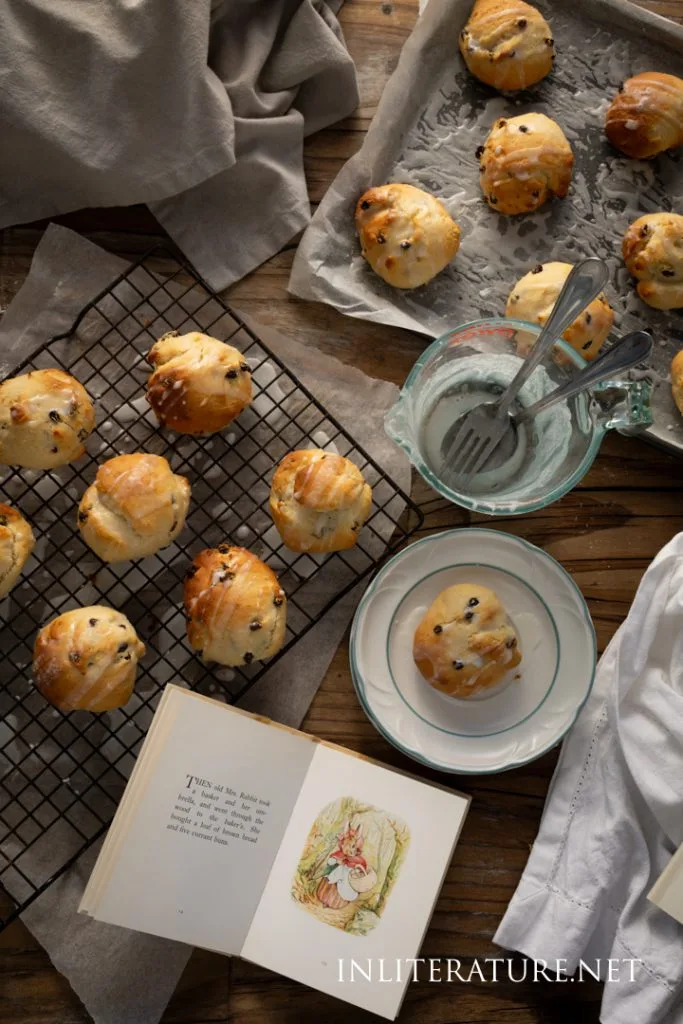
A currant bun is essentially a sweet bun studded with currants, though it takes various forms across the UK.
The nursery rhyme “Five Currant Buns in a Baker’s Shop” reflects its status as a staple in English bakeries, capturing one version as round and plump with a cherry on top.
However, the food writer Elizabeth David captured the complexity in categorising baked goods, who dedicated a chapter to differentiate smaller, individual cakes and buns from larger cakes or loaves, even though, as she says “… the dough or batter from which they are made may be identical with that used for a large cake or loaf.” David has followed the definition of a bun as “a small, soft, plump, sweet, fermented cake,” as per John Kirkland’s “The Bakers’ ABC” (1927).
Variations of Currant Buns in the UK
The diversity of recipes in the UK reflects regional variations. Some sweet buns or cakes with currants are named after their places of origin, which has made it easier to narrow down the possibilities of Mrs Rabbit’s currant bun version.
For instance, the Chelsea Bun, resembling a loosely rolled cinnamon roll with dried fruits, and the Hot Cross Bun, typically served at Easter, are variations of the term ‘currant bun’. David points out that Hot Cross Buns are essentially Spice Buns with slightly less milk to firm the dough for the traditional cross markings, for “if the dough is too soft, it will not take the cross cuts…”.
From Bristol, there’s the Colston Bun, similar to the Spice Bun, featuring currants, candied peel, spices, and a sugar syrup glaze.
David provides a recipe for Spiced Buns, which could resemble the currant buns bought by Mrs. Rabbit. Yet, we’ll explore a simpler version known as Tea Buns, shared by Mrs Broadbent in 1974 from the Isle of Wight. These buns use just currants to flavor a basic dough, representing the currant bun in its simplest form.
Currant Bun Tips
David recommends a few baking tips, such as only lightly sweetening the buns, keeping the fat content low, and warming the currants before mixing to help make sure the currants evenly distribute and prevent a ‘deadening’ effect on the dough.

History of Currants in British Baking
Currants, specifically the Zante or Black Corinth varieties, have a long, rich history in British baking. First introduced to the English market in the 14th century as Reysyns de Corauntz, by the 16th century, the name raisins of Corinth, named after the Peloponnesian city, became more commonly used. Over time, Corinth evolved to “currant.” By the 17th century, production primarily shifted to the Ionian island of Zakynthos (Zante), hence the name Zante currant.
Emerging internationally in the late 16th century, currants quickly became a staple in the English diet, valued for their sweetness at a time when sugar was a luxury. As an imported item and therefore deemed a luxury item, it was a luxury affordable to all. Quite quickly, they became extensively used in a variety of traditional British dishes, including fruitcakes, teacakes, and puddings, to add flavour and sweetness. The immense popularity of currants by the 17th century made them a cornerstone of the Levant Company, a key player in the industry, reportedly earning up to 300% profits from shipments of currants. By this period, the British demand was so high that it absorbed the entire Greek crop of currants annually.
Quote
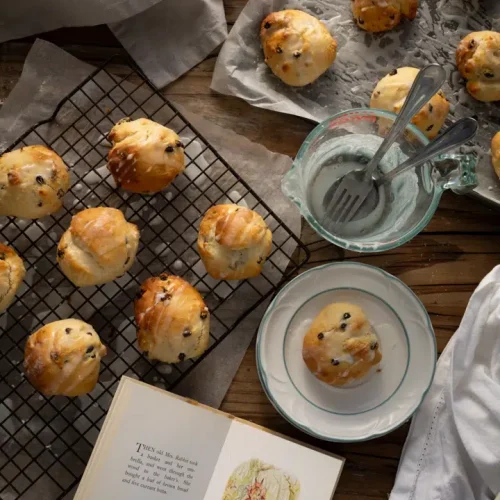
“Then old Mrs. Rabbit took a basket and her umbrella, and went through the wood to the baker’s. She bought a loaf of brown bread and five currant buns.”
-The Tale of Peter Rabbit, Beatrix Potter
British Currant Buns | The Tale of Peter Rabbit
Ingredients
- 1 1/4 cups 2% milk
- 4 tablespoons unsalted butter room temperature
- 1 large egg room temperature
- 2 teaspoons active dry yeast
- 1/4 cup granulated white sugar
- 1/3 cup currants
- 4 cups all-purpose flour
- pinch of salt
For Icing Glaze
- 1 cup confectioners’ icing sugar
- 2 tablespoons 2% milk
Instructions
- In a glass measuring cup, warm milk and butter in microwave at 50% power for 2 minutes, stirring halfway. Milk will be warm to the touch but not scalding hot.
- Whisk in egg with a fork until combined, then stir in yeast and sugar.
- Place currants in a large microwave-safe mixing bowl and microwave 100% for 40 seconds, stirring halfway.
- Stir in flour and salt to combine, then stir in milk mixture until a dough is formed.
- Cover with a tea towel and place in a warm spot for 1 hour to rise.
- Prepare 2 baking trays with parchment paper. Preheat oven to 400F (200C) or 375F(190C) if using fan-forced. Reposition oven racks to lowest and middle positions.
- Split the dough into 20 small buns and place them on baking trays. Cover with tea towels and let rise for 20 minutes.
- Place in oven and bake 15 minutes until golden brown.
- Remove and let cool for 15 minutes.
- Mix milk and icing sugar with a fork and drizzle over each bun with a spoon. Allow to dry 20 minutes, then serve.
Video
References
- Christensen, L. P. (2000). Raisin Production Manual. ANR Publications.
David, E. (1977). English Bread and Yeast Cookery. Allen Lane.
Gent, C. (2009). The case of currants: The Levant Company monopoly as a stimulus for Bristol’s illicit trade 1590-1666. Special Field Project, Bristol. Retrieved May 8, 2024, from https://www.bristol.ac.uk/Depts/History/Maritime/Sources/2009sfpgent.htm
“It was noon when we reached the quays and as all the labourers seemed to be eating their lunches, we bought two big currant buns and sat down to eat them on some metal piping beside the river.”.
From James Joyce’s :”The Encounter”