Buttered Scones | The Hobbit; An Unexpected Party
Jump to
Bilbo’s Buttered Scones from The Hobbit
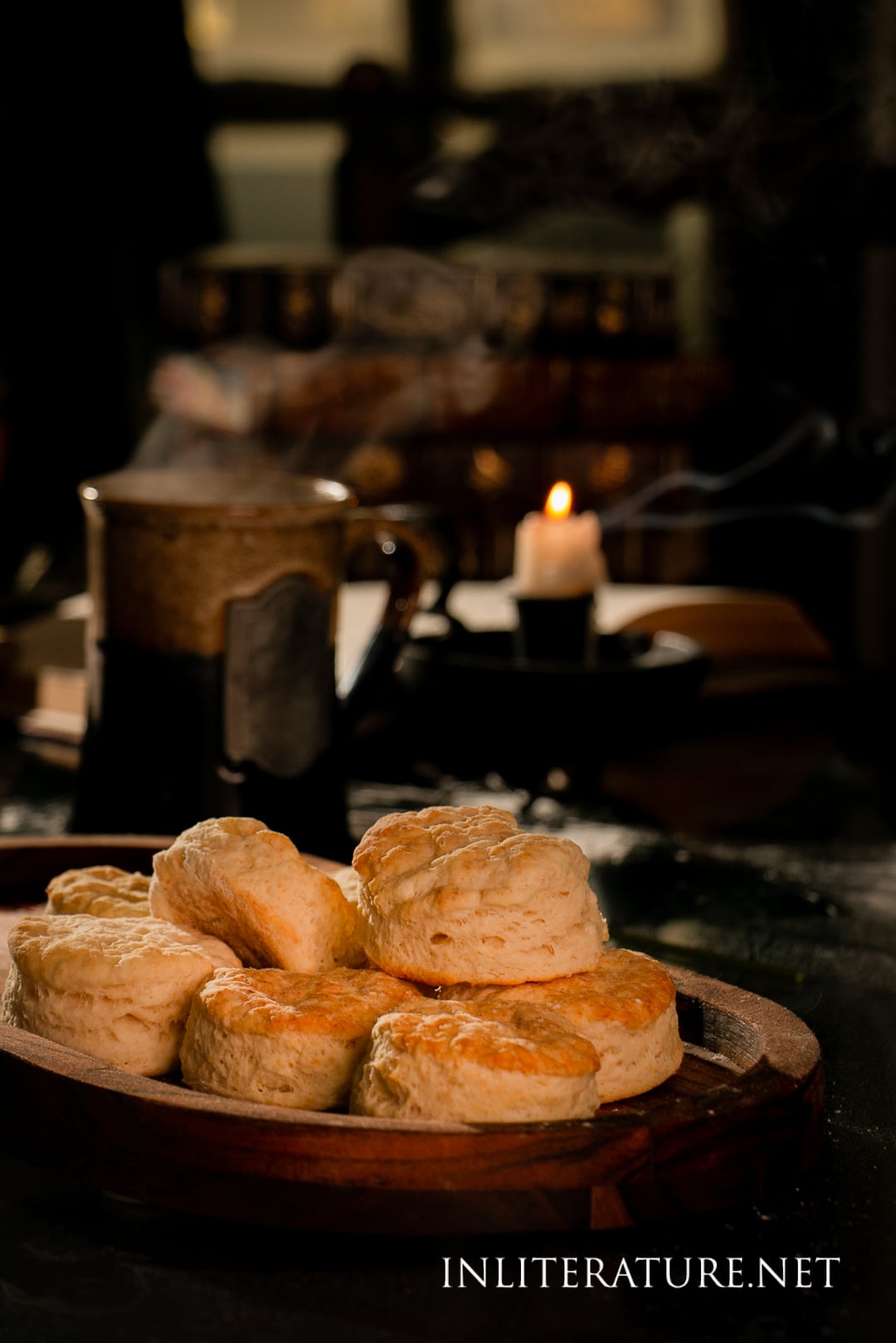
No afternoon tea in a Hobbit’s home is complete without a generous pile of scones, ready to be slathered with butter or with a side of jam and clotted cream. Follow four tips for perfect buttered scones each time to serve up buttered scones just like Bilbo would have done in The Unexpected Party.
Butter or cream?
Traditional plain scones are often served with butter for a simple, savory touch, while sweeter scones are typically paired with clotted cream for a more indulgent treat.
A Hobbit Day Feast Fit For A Dwarf
Scones are one of the many treats Bilbo Baggins serves to the dwarves from his well-stocked pantry in the chapter “An Unexpected Party” from The Hobbit. Planning your own Hobbit Day feast? Be sure to explore other delicious Hobbit-inspired recipes to complete the menu!
Perfect Scones: Tips and Techniques
For perfect fluffy scones, it’s all about technique and ingredients.
- Choose the Right Flour: Choose cake flour (a lower protein content), which creates a lighter texture.
- Embrace the Sifter: Sifting flour isn’t just a step. It adds air in to the mixture.
- Mix with Care: Avoid overworking the dough, which can compress and cause a dense scone.
- Chill with Cold Butter: Rubbing in cold butter creates layers within the dough, which creates a flaky finish. If melted butter is used, the moisture absorbs into the flour, leaving you with a dry scone when baked.
Making Scones Ahead of Time
Scones are best fresh from the oven. Some cooks swear by chilling the dough overnight before baking the following morning, which will also give you some early prep before your Hobbit party.
Historical Origins: From Hearth to Oven
Scones have evolved from their humble beginnings:
- Originally baked as one large round and sliced into wedges, today scones are baked as individual serves.
- Traditionally cooked on a griddle (called a girdle), hanging over an open fire.
- Baking soda and cream of tartar came into use in the late 1800s to help them rise.
- Scones were once traditionally cooked on a griddle (girdle), a flat circular iron plate, with a hooped handle to allow it to hang over a fire. Today, we’re using newfangled technology: the oven!


Quote
A big jug of coffee had just been set in the hearth, the seed-cakes were gone, and the dwarves were starting on a round of buttered scones, when there came a loud knock.
The Hobbit, J.R.R. Tolkien
Buttered Scones | The Hobbit; An Unexpected Party
Ingredients
- 1 ½ cups self-raising cake flour low protein
- 1 teaspoon castor sugar
- ½ teaspoon baking soda (bicarbonate of soda)
- ½ teaspoon cream of tartar
- 3 tablespoons cold butter (40g)
- ¾ cup buttermilk*
Instructions
- Preheat the oven to 200°C | 390°F.
- Sift flour, sugar, baking soda, and cream of tartar into a bowl.
- Cut butter into 1cm cubes. Rub it into the flour mixture with your fingertips until it resembles breadcrumbs. (Or use a mixer with a flat beater.)
- Gradually add buttermilk, mixing until a soft, spongy dough forms. You may not need the full amount.
- Turn the dough onto a floured surface and gently knead. Roll out to 1 inch thick.
- Cut into circles and place on a baking tray.
- Bake for 15–20 minutes until golden and risen.
Video
Notes
References
- Davidson, Alan., et al. The Oxford Companion to Food. Oxford University Press, 2014.
- White, F. Good Things in England: A Practical Cookery Book for Everyday Use, Containing Traditional and Regional Recipes Suited to Modern Tastes, Contributed by English Men and Women Between 1399 and 1932. J. Cape, 1932.
- https://www.thefreedictionary.com/griddle