Dracula Menus and Recipes

Bram Stoker’s
Dracula Menus & Recipes
Recreate the foods from Jonathan Harker’s journey through Transylvania as he makes his way to Count Dracula’s castle, from paprika chicken to mămăligă. Perfect for a Dracula-inspired Halloween party that blends Gothic storytelling with 19th-century flavour.
What food is in Dracula?
When Jonathan Harker begins his journey through Eastern Europe toward Count Dracula’s castle, his travel diary starts with records of details of the traditional fare he encounters with their unfamiliar flavours.
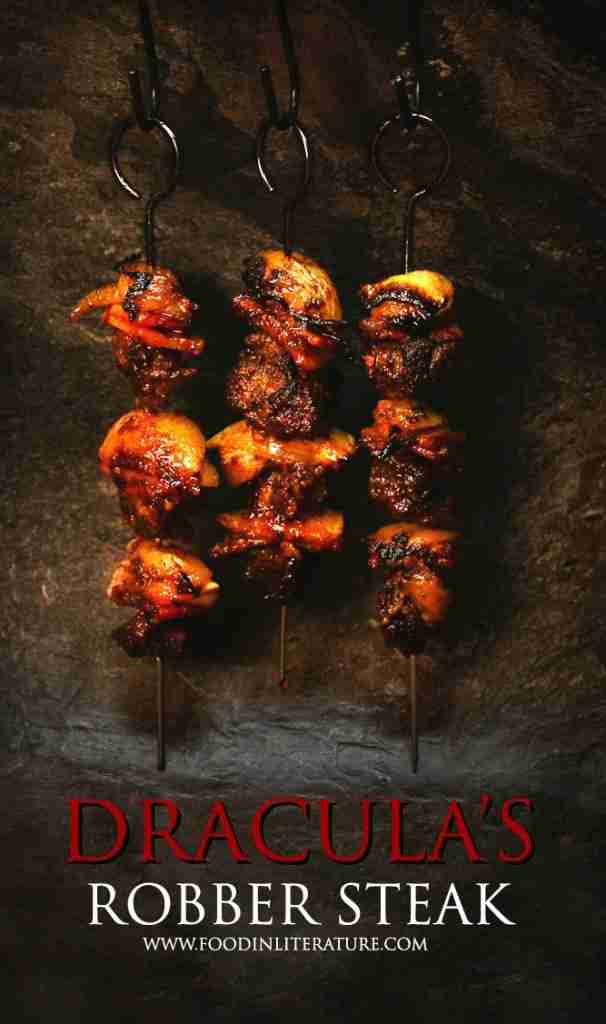
At Klausenburg, he dines on paprika hendl, a Hungarian-style chicken dish richly seasoned with red pepper. In Bistritz, breakfast brings mămăligă (a maize porridge similar to Italian polenta) and împlătată (stuffed eggplant). Supper that evening is robber steak, described as bits of bacon, onion and beef, roasted on sticks over an open fire and washed down with Golden Mediasch wine.
Later, at Castle Dracula, a table awaits him with roast chicken, cheese, salad, and a glass of old Tokay wine, while the Count himself “did not sup.”
The Cultural Cuisines and Influences Behind Dracula
Transylvania has a rich and complex history. Situated in the centre of Eastern Europe, it is a crossroads of cultures, of Hungarian, Romanian, Saxon (German), and Székely heritage, with Turkish and Slavic influences over the centuries. The result, through the lens of food, is a blend of cuisines that creates a fascinating melting pot.
However, Bram Stoker never visited Transylvania. Instead, he researched the region by borrowing books from the London Library and underlining passages that caught his imagination. Because Stoker never travelled to the region himself, the Transylvania of Dracula is a literary construct, a landscape stitched together, inspired by the writings of others.
Among his most heavily used sources were Emily Gerard’s The Land Beyond the Forest and Transylvanian Superstitions, A.F. Crosse’s Round About the Carpathians, and Charles Boner’s Transylvania: Its Products and Its People. His sources were not historians or cultural scholars, but travellers and memoirists who recorded what they saw (or thought they saw) through their own 19th-century Western lens. Their works blend observation with personal interpretation, often exoticizing what was unfamiliar or foreign to them. From Gerard, he drew details of local customs and dishes such as mămăligă. From Crosse, he borrowed the description for robber’s steak and even the plum brandy Slivovitz; and from Boner, he absorbed descriptions of rural life and mountain landscapes. The result is a Transylvania created by Stoker, loosely based on fact, but filtered through layers of imagination, travel writing and Gothic mood.
Choose a Recipe
Transylvanian Recipes Inspired by Dracula
Taste the world Bram Stoker imagined. Rustic Transylvanian dishes inspired by the pages of Dracula.
Robber Steak | Dracula
‘ “Robber steak”- bits of bacon, onion, and beef, seasoned with red pepper, and strung on sticks, and roasted over the fire, in simple style…
FAQs from Dracula
What food is mentioned in Dracula?
Chicken, paprika hendl, mamaliga, impletata, robber steak, roast chicken, cheese, salad, Tokay wine, Golden Mediasch wine, tea, coffee, hot soup, cured herrings, brandy, and port wine.
What wines are mentioned in Dracula?
Harker drinks Golden Mediasch and Tokay, both golden dessert wines popular in the 19th century, known for their sweetness and depth. Port wine is later consumed by Arthur Holmwood and Dr. Seward.
What does Count Dracula serve Jonathan Harker at the castle?
A supper of roast chicken, cheese, and salad, though the Count himself had already dined.
He has already dined, and he does not sup.